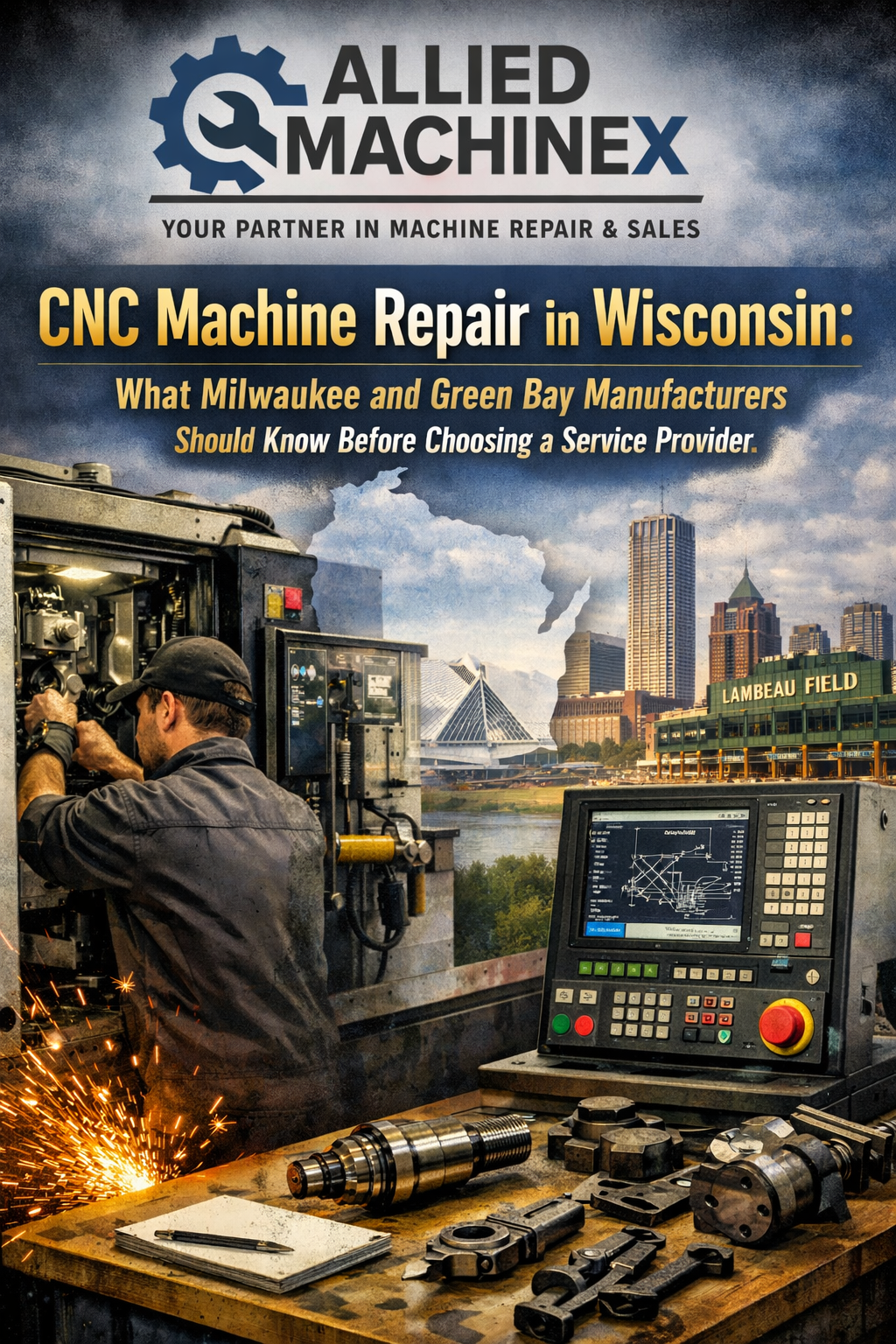
Your CNC machining center throws an alarm at 9 PM on a Friday. Production stops. Orders pile up. You need a technician who knows Fanuc controls, can diagnose spindle bearing failure, and won’t waste your time.
Wisconsin manufacturers face unique challenges. Paper mills run 24/7 shifts in Green Bay. Precision machine shops in Milwaukee hold aerospace tolerances. Metal fabricators can’t afford downtime during high-volume runs. When your Haas VMC or Mazak turning center goes down, you need a repair company that understands your operation.
This guide covers what Wisconsin manufacturers should look for in a CNC machine repair provider, the most common failures we see across the state, and how to minimize costly emergency repairs through preventive maintenance.
The Real Cost of CNC Downtime in Wisconsin Manufacturing
A single hour of downtime costs manufacturers between $5,000 and $20,000, depending on production volume. For paper mills running packaging equipment, that number climbs higher. For precision machine shops serving automotive or Harley-Davidson supply chains, missed delivery windows mean lost contracts.
The cost isn’t just lost production. You’re paying operators to stand idle. Rush shipping parts. Scrambling to meet customer commitments. Running overtime shifts to catch up.
Choosing the right CNC repair company before an emergency happens reduces these costs significantly.
What Makes CNC Machine Repair Different in Wisconsin
Wisconsin manufacturing differs from other Midwest states. The economy centers on paper mills, packaging machinery, food processing equipment, precision machining, metal fabrication, and heavy manufacturing. These markets demand technicians who understand specific equipment and processes.
A paper mill running a CNC lathe to machine rolls needs someone who grasps the 24/7 shift environment. A machine shop holding ±0.0001″ tolerances on aerospace parts needs a technician who won’t compromise accuracy during repairs.
Generic “machine repair” companies treat CNCs like any other equipment. Specialized CNC repair providers understand controller programming, servo tuning, ballscrew backlash compensation, and spindle bearing preload.
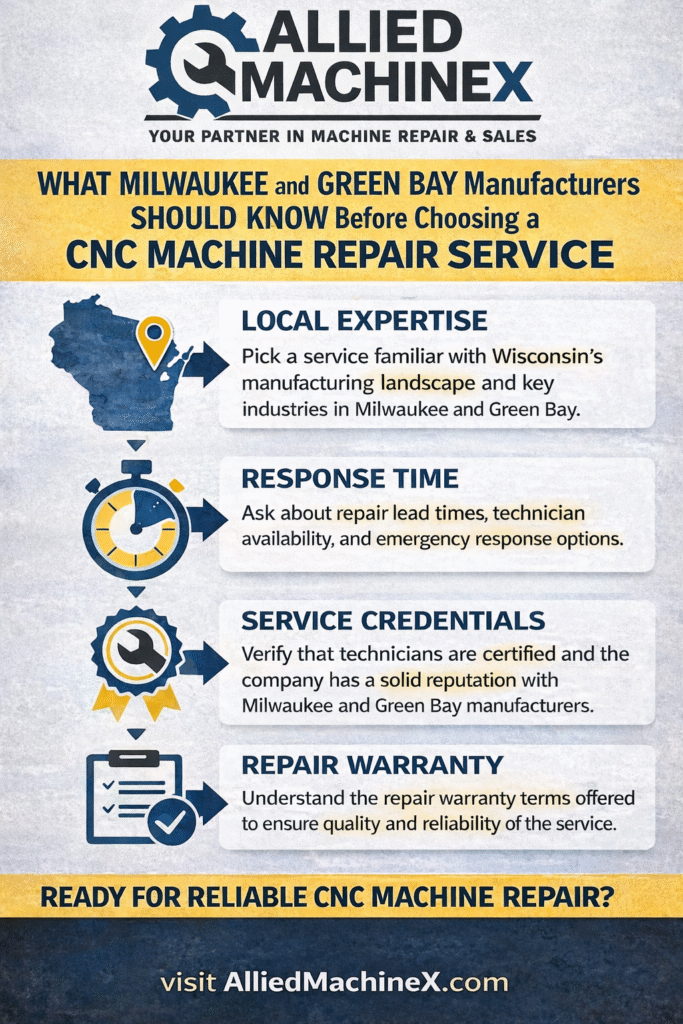
5 Critical Factors When Choosing a CNC Repair Company
1. Multi-Brand CNC Expertise
Your shop likely runs multiple machine brands. One provider should handle your Haas vertical machining center, Mazak turning center, and Okuma horizontal mill.
At Allied MachineX, we service all major CNC brands:
- Haas, Mazak, Okuma, Doosan, DMG Mori for machining centers
- Fanuc, Siemens, Mitsubishi, Heidenhain, and Fagor controls
- Hardinge, Mori Seiki, and Daewoo CNC lathes
If a repair company only services one or two brands, you’ll need multiple providers on call. That complicates emergency response and preventive maintenance scheduling.
2. 24/7 Emergency Response
CNC machines don’t break during business hours. A servo motor fails at midnight. A spindle bearing seizes on Saturday morning. A control board shorts during a Sunday shift.
True 24/7 emergency service means a technician answers the phone at 2 AM, not an answering service taking messages. We dispatch technicians across Wisconsin around the clock because we understand manufacturers run continuous operations.
3. Remote Diagnostics Capability
Many CNC failures can be diagnosed remotely before a technician arrives. This saves time and money. A technician reviewing alarm codes, checking parameter settings, and analyzing servo drive errors over a secure connection identifies the problem immediately.
Remote diagnostics mean:
- Faster identification of failed components
- Parts ordered before the technician arrives
- Reduced on-site troubleshooting time
- Lower overall repair costs
Not every repair company offers remote diagnostics. Those that do reduce your downtime significantly.
4. Parts Sourcing and Inventory
Common wear items fail predictably. Spindle bearings. Servo motors. Drive boards. A repair company with parts inventory or strong supplier relationships gets your machine running faster than one ordering parts after diagnosis.
We maintain relationships with major parts suppliers and stock common failure items for Haas, Mazak, and Okuma machines. For specialized components, we source directly from OEM suppliers or qualified rebuild shops.
5. Preventive Maintenance Programs
Emergency repairs cost 3-5 times more than scheduled preventive maintenance. A PM program catches failing components before they cause production downtime.
Quarterly or semi-annual preventive maintenance includes:
- Spindle bearing inspection and vibration analysis
- Servo motor and drive diagnostics
- Ballscrew and linear guide lubrication
- Control backup and battery replacement
- Pneumatic system pressure testing
- Hydraulic fluid analysis and filter replacement
Manufacturing facilities that implement PM programs reduce emergency repair frequency by 60-70%.
Most Common CNC Failures in Wisconsin Manufacturing
Over 15 years of servicing CNC machines across Wisconsin, we see the same failures repeatedly:
Spindle Bearing Failure
Symptoms include unusual vibration, poor surface finish, thermal alarms, or grinding noises. Spindle bearings fail from contamination, improper lubrication, or normal wear. A failed spindle bearing requires complete spindle removal and rebuild or replacement.
Servo Motor Issues
Servo motors fail from electrical overload, bearing wear, or encoder damage. Symptoms include the following errors, unusual motor noise, or excessive current draw. Servo replacement or rebuild typically takes 4-8 hours, depending on machine access.
Control Board Failures
Fanuc, Siemens, and Mitsubishi control boards fail from power surges, component aging, or cooling system problems. Control failures causea complete machine shutdown. Replacement or repair requires proper backup procedures to restore machine parameters.
Ballscrew and Linear Guide Wear
Ballscrews wear from inadequate lubrication or contamination. Symptoms include positioning errors, unusual noise, or visible wear marks. Ballscrew replacement requires careful alignment and backlash compensation programming.
Coolant System Problems
Coolant pumps, filters, and level sensors fail regularly. While not stopping production immediately, coolant problems cause tool wear, poor surface finish, and eventual spindle damage from insufficient chip clearing.
Industry-Specific CNC Repair Considerations in Wisconsin
Paper and Packaging Equipment
Paper mills and packaging facilities across Wisconsin run CNC lathes to machine rolls, shafts, and precision components for converting equipment. These facilities operate 24/7 with minimal downtime windows.
CNC repair in Green Bay and surrounding areas for paper industry equipment requires understanding of heavy-duty lathe operations, experience with large swing diameter machines, ability to work within tight maintenance windows, and knowledge of contamination issues from paper dust.
Precision Manufacturing
Precision machine shops serve aerospace, medical device, and automotive markets. These facilities hold extremely tight tolerances and run high-mix, low-volume production.
CNC repair in Milwaukee and the surrounding industrial corridor for precision manufacturing requires geometric accuracy verification after repair, understanding of high-precision machining requirements, experience with 5-axis machining centers, and knowledge of probing systems and tool management.
Questions to Ask Before Hiring a CNC Repair Company
“What brands and controls do you regularly service?”
A provider should list specific brands and control systems. “We service all brands” often means limited experience with any particular system.
“Do you offer remote diagnostics?”
Remote diagnostics save time and money. If they don’t offer this service, you’re paying for diagnostic time on-site.
“What’s your average response time for emergencies?”
“24/7 service” doesn’t always mean fast response. Get specific timeframes for your location.
“Can you provide references from similar manufacturing facilities?”
A company servicing paper mills should provide paper mill references. A company servicing precision machine shops should provide precision machining references.
“What preventive maintenance programs do you offer?”
PM programs should be customized to your equipment and production schedule, not one-size-fits-all packages.
The Hidden Costs of Choosing the Wrong Repair Company
The cheapest service call often becomes the most expensive repair.
Inexperienced technicians misdiagnose problems, replace the wrong components, and extend downtime. A $1,500 servo motor replacement becomes a $6,000 repair when the actual problem was a faulty encoder cable.
Lack of parts availability adds days to simple repairs. A servo motor that should take 4 hours to replace takes 3 days waiting for parts.
Poor-quality replacement parts fail prematurely. Saving $500 on an aftermarket spindle bearing costs $8,000 when it fails 6 months later during a critical production run.
No preventive maintenance capability means you’re stuck in reactive mode, always responding to emergencies instead of preventing them.
Preventive Maintenance: Your Best Investment
A proper preventive maintenance program costs 20-30% of typical annual emergency repair expenses while reducing emergency frequency by 60-70%.
Quarterly PM visits for a typical 3-axis vertical machining center cost $400-600. Annual emergency repairs for the same machine without PM average $3,000-5,000.
PM programs also extend machine life. A well-maintained CNC machine operates reliably for 15-20 years. Machines without regular PM require major rebuilds or replacement after 8-10 years.
Wisconsin manufacturers running multiple shifts benefit most from PM programs. Continuous operation accelerates wear, making scheduled maintenance essential.
When to Repair vs. Replace CNC Equipment
Not every machine failure justifies repair. Sometimes replacement makes more economic sense.
Repair makes sense when:
- The machine is less than 15 years old
- Parts are readily available
- The repair cost is less than 40% of the replacement cost
- The machine meets current production requirements
- The control system supports current programming needs
Replacement makes sense when:
- Repair costs exceed 50% of the replacement cost
- Parts are no longer available
- The machine’s accuracy no longer meets requirements
- The control system is obsolete
- You’ve experienced multiple major failures in 12 months
We help Wisconsin manufacturers make this decision honestly. Sometimes a repair isn’t the best answer. Our refurbished machine inventory provides cost-effective alternatives when replacement makes more sense.
Working with Allied MachineX in Wisconsin
We’ve serviced CNC machines across Wisconsin for over 15 years. Our technicians understand the unique demands of paper mill operations, precision manufacturing, and everything in between.
Our approach:
- 24/7 emergency response with actual technicians, not answering services
- Remote diagnostics to reduce on-site troubleshooting time
- Multi-brand expertise across Haas, Mazak, Okuma, Doosan, and DMG Mori
- Preventive maintenance programs customized to your production schedule
- Honest assessments about repair vs. replacement decisions
We service all major CNC controls, including Fanuc, Siemens, Mitsubishi, Heidenhain, and Fagor. Our technicians perform spindle rebuilds, servo motor replacement, ballscrew replacement, control board repair, and complete machine retrofits.
Next Steps for Wisconsin Manufacturers
CNC machine reliability starts with choosing the right repair partner before emergencies happen.
If you’re running Haas, Mazak, Okuma, or other CNC equipment in Wisconsin, contact Allied MachineX at 844-763-1748. We’ll discuss your equipment, production requirements, and develop a preventive maintenance plan that reduces emergency repairs and extends machine life.
Don’t wait for a breakdown at midnight on Friday to find out your current repair company can’t help. Establish a relationship with a qualified CNC repair provider now.