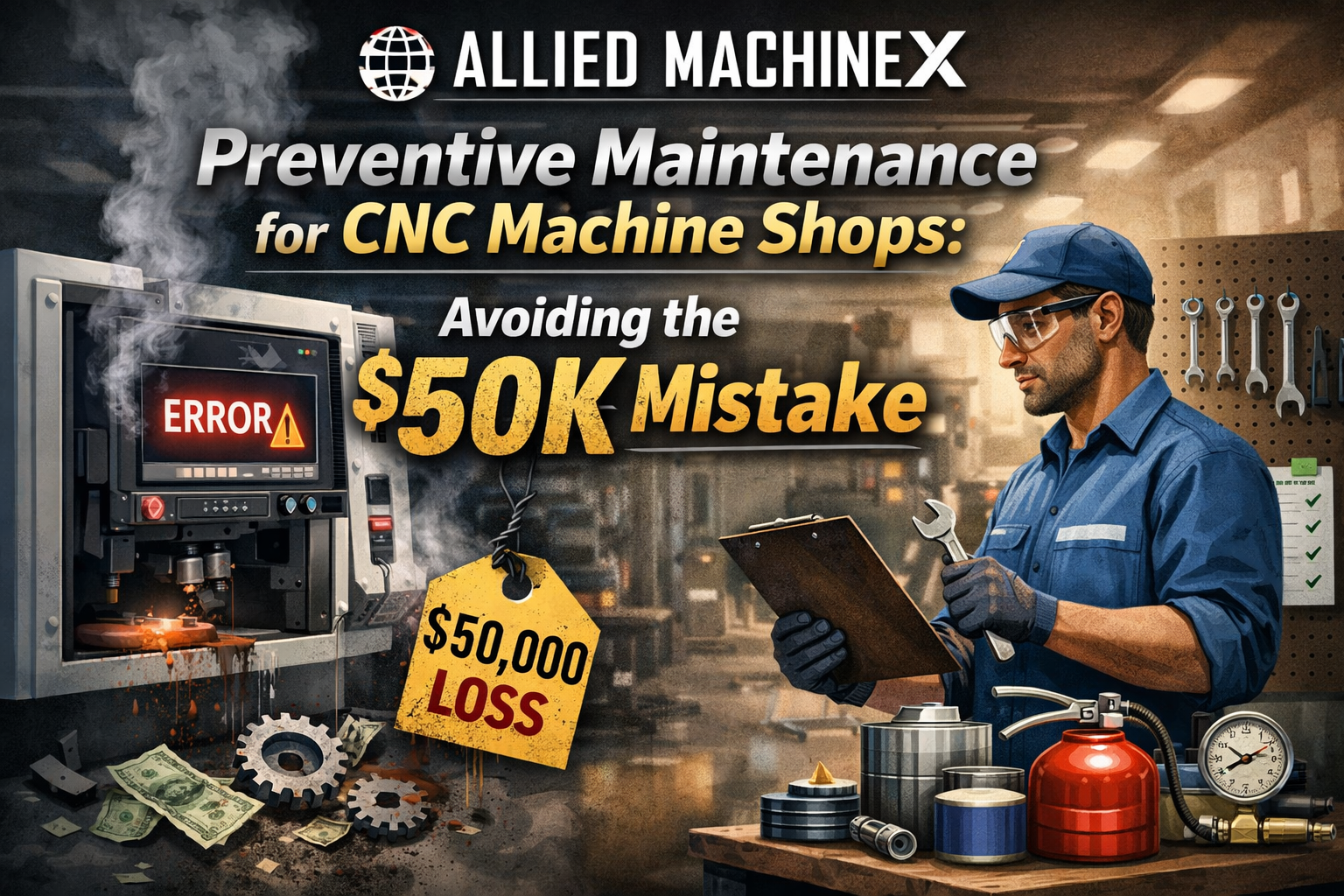
A CNC machining center doesn’t announce when it’s about to fail. There’s no warning light that says “spindle bearings have 72 hours left” or “way lubrication system failing—expect catastrophic failure Tuesday at 2 PM.”
Instead, your Haas VF-3 runs fine on Thursday. Friday morning, the spindle seizes mid-cut. Production stops. You’ve got a $35,000 spindle rebuild, three weeks of downtime, and a customer threatening to pull their contract because you can’t deliver parts.
That’s the $50K mistake—and it’s completely preventable.
Preventive maintenance isn’t about following the machine manual religiously. It’s about understanding how industrial equipment actually fails in real production environments and catching problems before they cascade into catastrophic breakdowns.
Why Most Machine Shops Get Maintenance Wrong
Walk into most precision machine shops, and you’ll find a pattern: operators check coolant levels, clean chips, maybe grease some ways on Friday afternoon. The machine manual sits in a drawer somewhere. Maintenance happens when something breaks.
This approach works until it doesn’t.
CNC machines are complex mechanical systems running at high speeds under significant loads. A single component failure—a worn ballscrew, contaminated hydraulic fluid, degraded spindle bearing—can trigger a chain reaction that destroys multiple systems simultaneously.
The shops that avoid catastrophic failures understand something fundamental: every machine component has a predictable service life. Spindle bearings wear out. Way systems accumulate contamination. Hydraulic seals degrade. Electrical components fail from heat cycling.
You can replace a ballscrew during a scheduled maintenance window for $8,000. Or you can wait until it fails catastrophically during a production run, damages the machine saddle, ruins the part in process, and costs $40,000 plus three weeks of downtime.
Maintenance Schedules That Actually Work
Machine manufacturers publish maintenance schedules. The problem? They’re written for ideal operating conditions—climate-controlled facilities running 8-hour shifts on clean material with perfect coolant management.
Your shop runs two 10-hour shifts, machines pre-hardened tool steel, and the coolant system gets topped off when someone remembers. Real-world maintenance needs to account for actual operating conditions.
Daily Checks (5 Minutes)
- Coolant level and condition (contamination, bacteria growth)
- Hydraulic fluid level
- Air pressure to the machine (the most overlooked cause of intermittent faults)
- Unusual sounds or vibrations during warmup
- Chip accumulation in critical areas
Weekly Checks (20 Minutes)
- Way lubrication system operation (confirm lubrication is actually reaching the ways)
- Spindle warmup behavior (listen for bearing noise)
- Hydraulic pressure readings
- Electrical cabinet temperature (hot spots indicate failing components)
- Backup battery voltage for absolute encoders
Monthly Maintenance (2-3 Hours)
- Complete way system cleaning and fresh lubrication
- Coolant system service (remove sludge, check for bacteria)
- Hydraulic filter replacement or inspection
- Spindle taper cleaning and inspection
- Tool holder and collet inspection
- Machine geometry check (basic accuracy verification)
Quarterly Service (4-6 Hours)
- Full ballscrew and way inspection
- Spindle bearing condition assessment
- Hydraulic system service
- Electrical cabinet cleaning and connection inspection
- Machine calibration and accuracy verification
- Replace worn components before they fail
Annual Service (8-12 Hours)
- Complete machine teardown and inspection of critical components
- Spindle rebuild or bearing replacement (typically every 3-5 years, depending on usage)
- Way reconditioning if needed
- Complete hydraulic system flush
- Electrical system testing
- Full machine calibration witha laser interferometer
The Components That Fail First
Not all machine components are created equal. Some wear predictably. Others fail suddenly. Understanding which is which determines whether you schedule maintenance or deal with emergency breakdowns.
Spindle bearings: The most expensive failure on a machining center. Angular contact bearings in a CNC spindle experience massive loads and heat cycling. Typical service life is 10,000-15,000 operating hours under normal conditions. Cut that in half if you’re running heavy, interrupted cuts, working with abrasive materials, or experiencing coolant contamination.
Warning signs: Increasing spindle warmup time, temperature rise during operation, unusual noise, or declining surface finish quality. By the time you hear grinding or squealing, you’re hours from catastrophic failure.
Ballscrews: Precision ballscrews wear from contamination, inadequate lubrication, or simple accumulated mileage. A worn ballscrew shows up as positioning errors, backlash, or inconsistent part dimensions.
Most shops notice the accuracy problems but don’t connect them to ballscrew wear. By the time diagnosis happens, the screw has damaged the nut, and now you’re replacing both components, plus dealing with dimensional issues in recent production.
Way systems: Box ways accumulate metal particles and contamination despite the way covers. Linear guides experience bearing race degradation. Both fail gradually until they don’t—sudden catastrophic failures that damage machine geometry.
Prevention is straightforward: regular cleaning, proper lubrication, and periodic inspection. Waiting until you see visible wear means you’ve already damaged the machine.
Hydraulic systems: Contaminated hydraulic fluid destroys pumps, valves, and cylinders. Most shops change hydraulic fluid when it “looks dirty.” That’s far too late. Microscopic contamination damages components long before you see visible degradation.
Proper hydraulic maintenance means scheduled fluid changes, filter replacement, and system flushing—not waiting for visible problems.
Coolant systems: Bacteria growth, chip contamination, and chemical degradation turn coolant from a machining aid into a source of problems. Contaminated coolant causes tool wear, surface finish problems, and—critically—spindle bearing damage from coolant infiltration.
Cost Analysis: Planned Maintenance vs. Emergency Breakdown
The economics of preventive maintenance are straightforward when you look at typical industry costs. Let’s use a Haas VF-3 running two shifts as an example.
Typical annual preventive maintenance investment:
- Daily/weekly operator checks: Included in normal operation
- Monthly service (in-house): 30 hours of labor annually
- Quarterly professional service: $2,000-3,000 annually
- Annual service: $5,000-7,000
- Consumables and wear parts: $2,000-3,000
Total annual investment: $9,000-13,000
Typical emergency breakdown costs (that maintenance helps avoid):
- Spindle failure: $25,000-40,000 (rebuild + downtime)
- Ballscrew failure: $15,000-25,000 (parts + installation + recalibration)
- Way system damage: $20,000-50,000+ (significant machine teardown)
- Lost production during downtime: $5,000-15,000 per week
- Rush charges for customer delivery: Variable
- Reputation damage: Unquantifiable
Single prevention of catastrophic failure can pay for years of maintenance investment.
What You Can Do In-House vs. When to Call Professionals
Not all maintenance requires professional service. Understanding what your team can handle versus when to bring in specialists saves money while avoiding mistakes.
In-house maintenance capabilities:
- Daily and weekly checks
- Way system cleaning and lubrication
- Coolant system service
- Basic spindle taper cleaning
- Filter replacements
- Visual inspections
Professional service requirements:
- Spindle bearing assessment and rebuild
- Ballscrew replacement and machine geometry restoration
- Hydraulic system diagnosis and repair
- Electrical system troubleshooting
- Machine calibration and accuracy verification
- Component-level diagnosis of intermittent failures
The mistake most shops make? Attempting complex repairs without proper diagnostic equipment or expertise. A misdiagnosed spindle bearing problem becomes a much bigger issue when someone damages the spindle taper trying to “fix” bearing noise without the right tools or training.
Remote Diagnostics: The Modern Maintenance Advantage
Modern CNC machines generate extensive diagnostic data. Alarm histories, servo load data, spindle temperature curves, and system performance metrics tell experienced technicians exactly what’s failing before catastrophic breakdown occurs.
Remote diagnostic capabilities allow professional technicians to analyze machine performance without an initial on-site visit. Machine diagnostic data can reveal whether unusual spindle noise requires immediate attention or can wait until the next scheduled maintenance window.
This approach has helped shops catch problems early. Contaminated spindle bearings caught through remote analysis can sometimes be cleaned and re-lubricated, preventing the need for complete bearing replacement that would be required after full failure.
Real-World Maintenance Scenarios
Scenario 1: The “It’s Fine” Spindle
A precision parts manufacturer noticed their Mazak VTC-200 was producing slightly rougher surface finishes. Not terrible. Still within print specifications. They adjusted speeds and feeds to compensate.
Three weeks later, the spindle seized mid-cut. Complete bearing failure. Major rebuild costs, weeks of downtime, and a customer audit because delivered parts showed declining quality over the previous month.
The surface finish degradation was the warning. Early bearing wear creates microscopic runout that shows up as surface finish problems long before you hear noise or feel vibration. Scheduled bearing inspection catches this early when intervention is less expensive and disruptive.
Scenario 2: The Mysterious Accuracy Problem
A job shop running Haas machines started seeing dimensional inconsistencies. Same program, same setup, but parts are measured differently day-to-day. They replaced tooling, recalibrated the probe system, and blamed material variation.
The actual problem? Worn ballscrews create positioning inconsistencies that vary with temperature and load. By the time the diagnosis happened, the ballscrew nut had damaged the screw, requiring complete replacement of both components plus machine geometry restoration.
Quarterly ballscrew inspection with a dial indicator would have identified the wear when only the nut needed replacement—significantly less expensive than replacing both components.
Scenario 3: The Hydraulic System Everyone Ignores
Hydraulic systems fail slowly. Pressure drops slightly. Tool change times increase incrementally. Most operators never notice until the automatic tool changer stops working entirely.
A tool and die shop ran its DMG Mori NVX-5000 for six years without hydraulic service. When the ATC finally failed, contamination had destroyed the hydraulic pump, multiple valves, and damaged the tool changer mechanism. Major repair costs plus weeks of downtime.
Annual hydraulic fluid analysis costs a few hundred dollars. It identifies contamination years before component damage occurs.
Building a Maintenance Program That Actually Gets Done
The best maintenance schedule is worthless if nobody follows it. Effective maintenance programs need three elements:
1. Clear responsibility assignment: Someone owns each maintenance task. “Everyone’s responsibility” means nobody’s responsibility.
2. Simple documentation: A one-page checklist beats a 50-page manual that nobody reads. Record what was done, what was found, and when the next service is due.
3. Realistic scheduling: Maintenance needs to fit production schedules. Quarterly service during a slow period works better than arbitrary calendar dates that conflict with rush jobs.
When Emergency Service Makes Sense
Despite best efforts, unexpected failures happen. A power surge damages the drive. A coolant leak floods the electrical cabinet. A tool breaks and damages the spindle taper.
Emergency service capabilities matter when production stops unexpectedly. Response time, diagnostic expertise, and parts availability determine whether you’re down for hours or weeks.
Allied MachineX provides 24/7 emergency service to precision manufacturers throughout Indiana, including South Bend and Indianapolis, because machine breakdowns don’t respect business hours. When production stops unexpectedly, experienced technicians can diagnose problems remotely and dispatch the necessary parts to minimize downtime.
The Bottom Line
Preventive maintenance isn’t an expense—it’s the cheapest insurance policy you’ll ever buy. The cost of scheduled service is a fraction of emergency breakdown expenses, and the operational stability is worth even more than the direct cost savings.
Every precision machine shop faces the same choice: invest in maintenance or pay for emergency repairs. The shops that consistently deliver on-time, maintain quality standards, and avoid catastrophic downtime all made the same decision.
They chose maintenance.
Need professional CNC maintenance service or emergency repair support? Allied MachineX provides comprehensive machine maintenance, diagnostic services, and emergency repair throughout Indiana and the Midwest. Contact us at 844-763-1748 or visit machinerepairandsales.com to discuss your specific maintenance needs and schedule an assessment.